


18 Aug Where the Music Begins: The Craft of Randal Eller
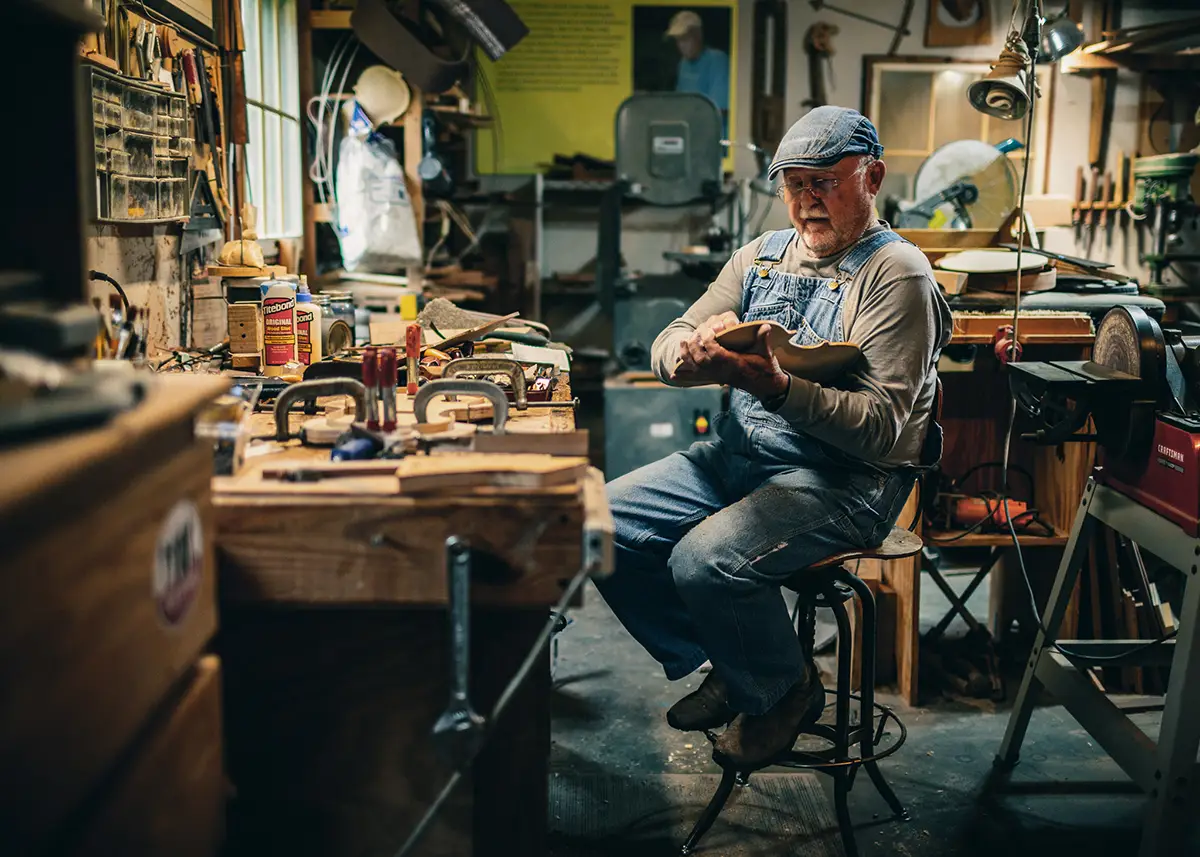
In a quiet shop behind his home in Chilhowie, Virginia, Randal Eller leans over a fiddle in progress. The light filters through sawdust in the air. The smell of applewood and beeswax fills the room. This is where music begins, not with a musician, but with a craftsman who understands that every instrument carries more than tone. It carries the rhythm of mountain life, the patience of hand tools, and the quiet pride of a man who gives old wood new purpose.
Randal has spent more than forty years shaping the instruments of Southwest Virginia. His journey began in 1982, when he met legendary luthier Albert Hash at one of the early Hungry Mother Festivals. Inspired by that encounter, he went home and built his first fiddle. It was a project that lit something in him. As a carpenter and homebuilder by trade, he was no stranger to working with wood. But fiddle-making offered something more personal. “You put more of yourself into it,” he says.
Inside his workshop, Randal crafts fiddles, guitars, and mandolins with quiet precision, relying mostly on hand tools and years of experience. He also restores instruments that have weathered decades of use. One of his most memorable repairs involved a large stand-up bass that required rebuilding the entire top from scratch. It was a slow, meticulous process. But when he returned the finished instrument, the look of gratitude on the musician’s face made every hour worth it.
Each of Randal’s creations reflects his deep roots in the region. He often uses traditional tonewoods, including applewood harvested from historic orchards in Chilhowie. Some pieces are made for commission, while others are gifts for family, friends, or students. Craftsmanship runs deep in the Eller family. His brother builds Windsor chairs. His sister weaves baskets. His grandson plays music and installs cabinetry. Many of his children and grandchildren are musicians, and most of them live in homes Randal built himself.
He continues to pass on his knowledge to others, teaching private lessons at the Wayne C. Henderson School in Marion. For Randal, recognition has never been the point. What matters is the work. His advice to new luthiers is simple and sincere. “Make sure you enjoy it,” he says. “It won’t feel like work if it comes from the heart.”
Randal Eller’s instruments are more than tools for making music. They are heirlooms of sound and story, shaped by someone who understands that craftsmanship begins long before the first note. In every carving, joint, and curve, he honors the past while giving shape to the future. And when he places a finished piece into someone’s hands, he offers more than an object. He offers a legacy that will play on, one note at a time.